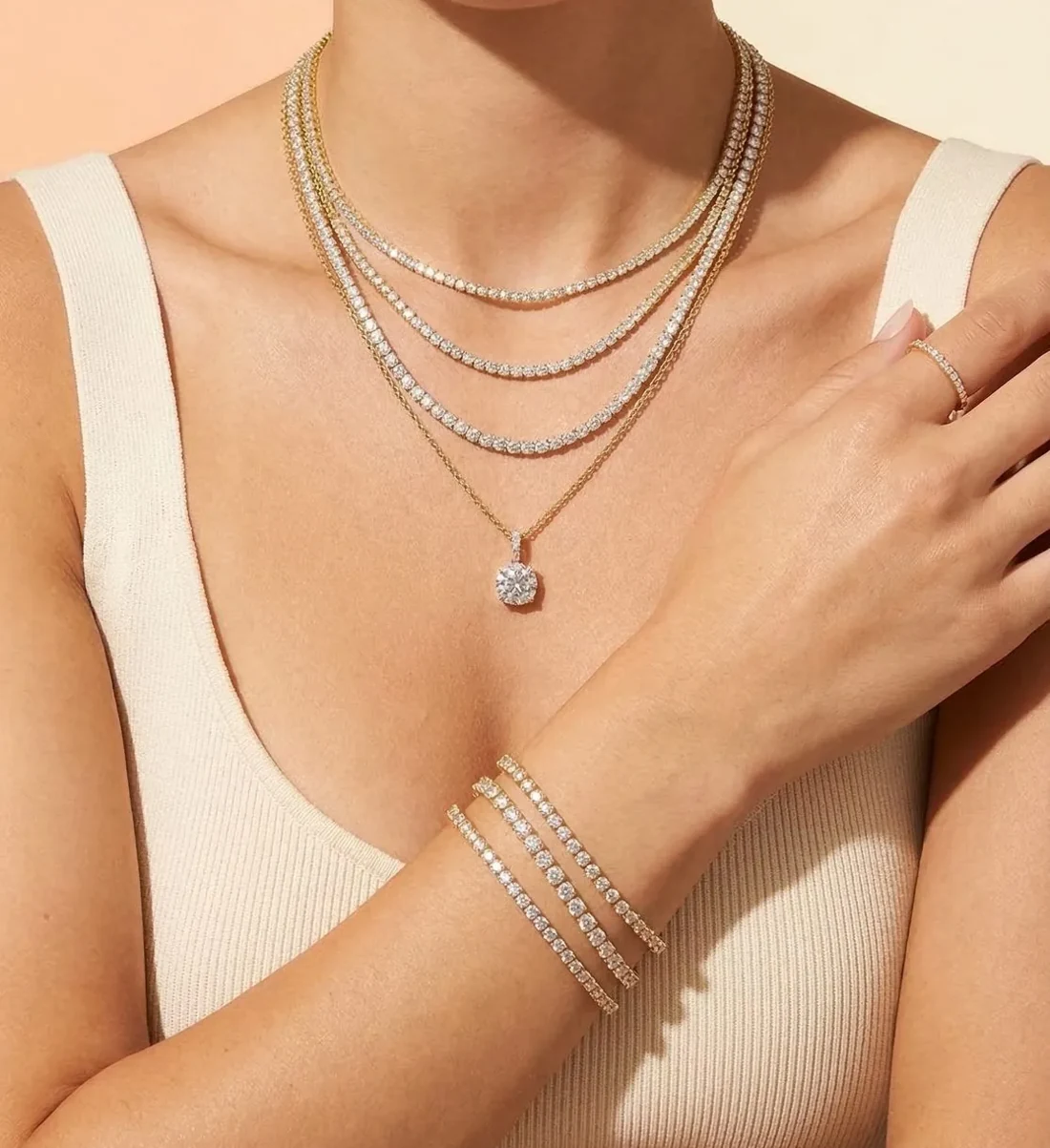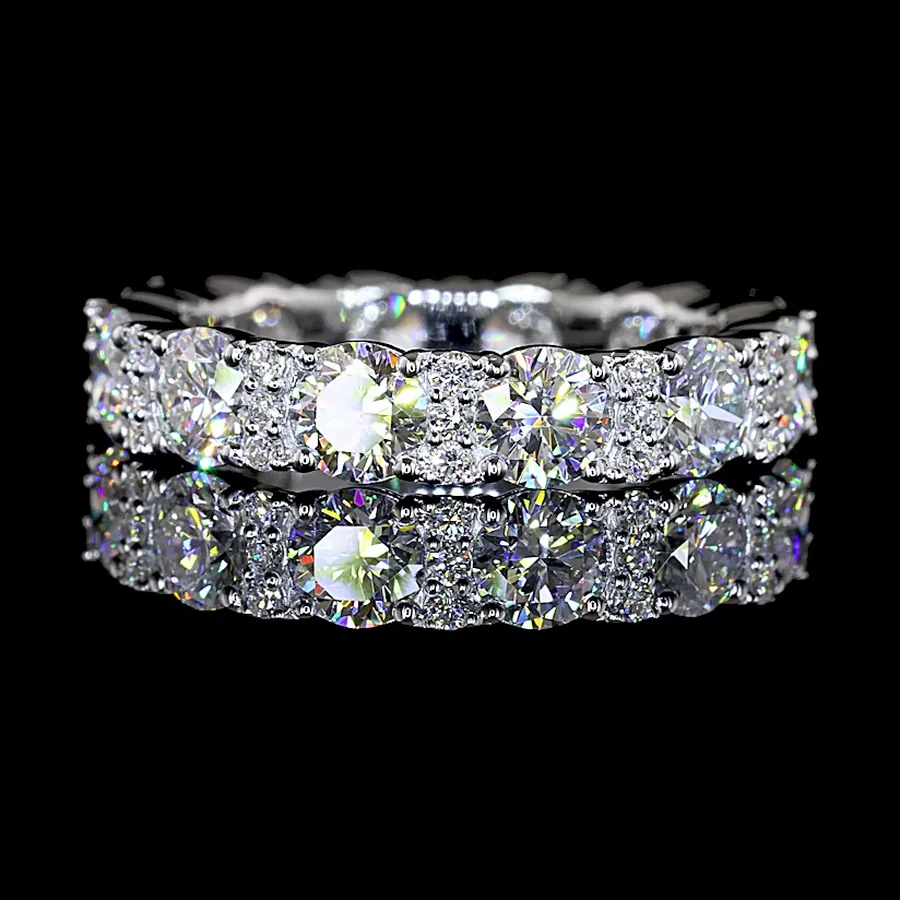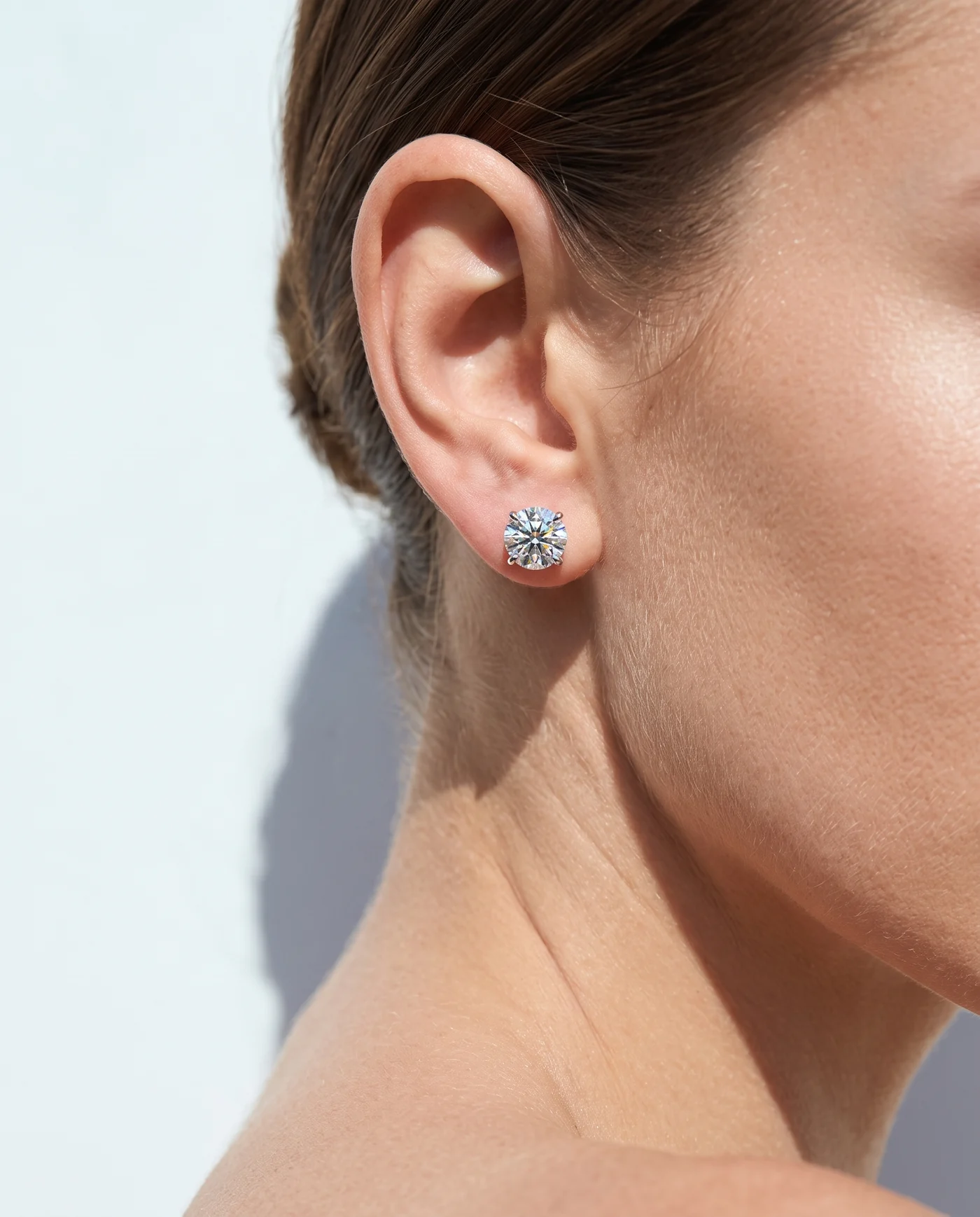
Moissanite is silicon carbide. A lab-grown diamond is carbon, the same crystal as a mined diamond. They differ in how they handle light, how hard they are, how they are graded, and in what the word diamond means on a receipt. Dorvelle sets lab-grown diamonds and not moissanite, because a diamond is a diamond in any light.
Two different materials
Moissanite is silicon carbide, one silicon atom to one carbon, grown in a lab; a lab-grown diamond is pure carbon in the cubic crystal structure that defines a diamond, so the two are different gems, not two versions of one.
Moissanite is silicon carbide, SiC, one silicon atom to one carbon. The French chemist Henri Moissan found tiny crystals of it in 1893 in fragments of a meteorite from Arizona and at first took them for diamond. He identified the material as silicon carbide in 1904. Natural moissanite is vanishingly rare, so every moissanite in jewelry is grown in a lab. Charles & Colvard brought it to the jewelry market in 1998 under patent, and it has been sold as a diamond alternative since.
A lab-grown diamond is carbon crystallized in the same cubic structure as a mined diamond. The FTC’s jewelry guides define a diamond as a mineral consisting essentially of pure carbon crystallized in the isometric system, and a lab-grown stone meets that definition. It must be disclosed as laboratory-grown, which we do on every page, but it is a diamond, chemically, optically and physically. Our lab-grown guide covers how the stones are grown.
| Moissanite | Lab-grown diamond | |
|---|---|---|
| Material | Silicon carbide | Carbon |
| Refractive index | 2.65 to 2.69 | 2.42 |
| Dispersion | 0.104 | 0.044 |
| Mohs hardness | 9.25 | 10 |
| Independent grading | None | IGI or GIA report |
Sparkle
Moissanite bends light more than diamond, with a refractive index of 2.65 to 2.69 against diamond’s 2.42, and splits it into color more than twice as much, with a dispersion of 0.104 against 0.044.
Refractive index describes how strongly a gem bends light; dispersion describes how far it splits white light into color.
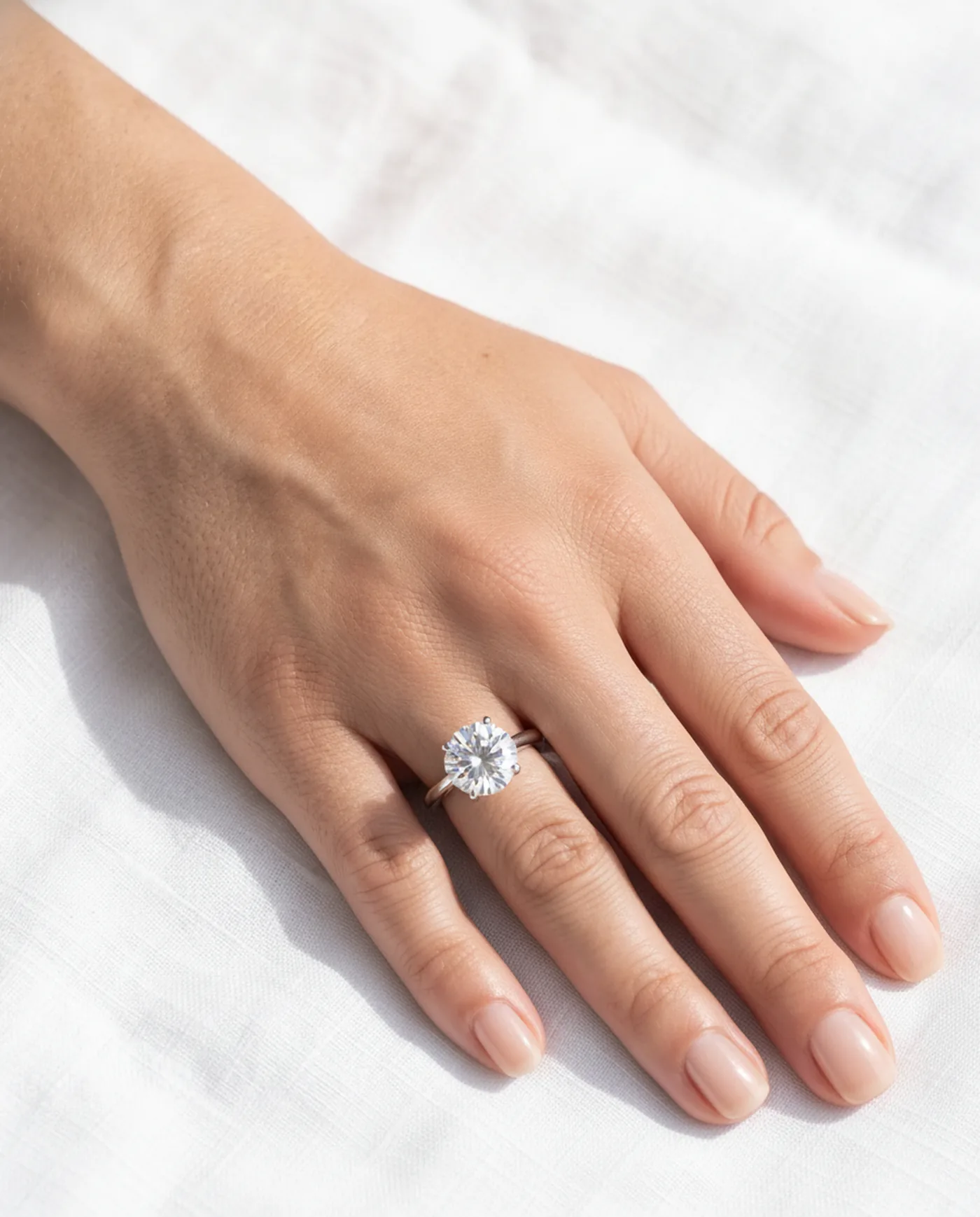
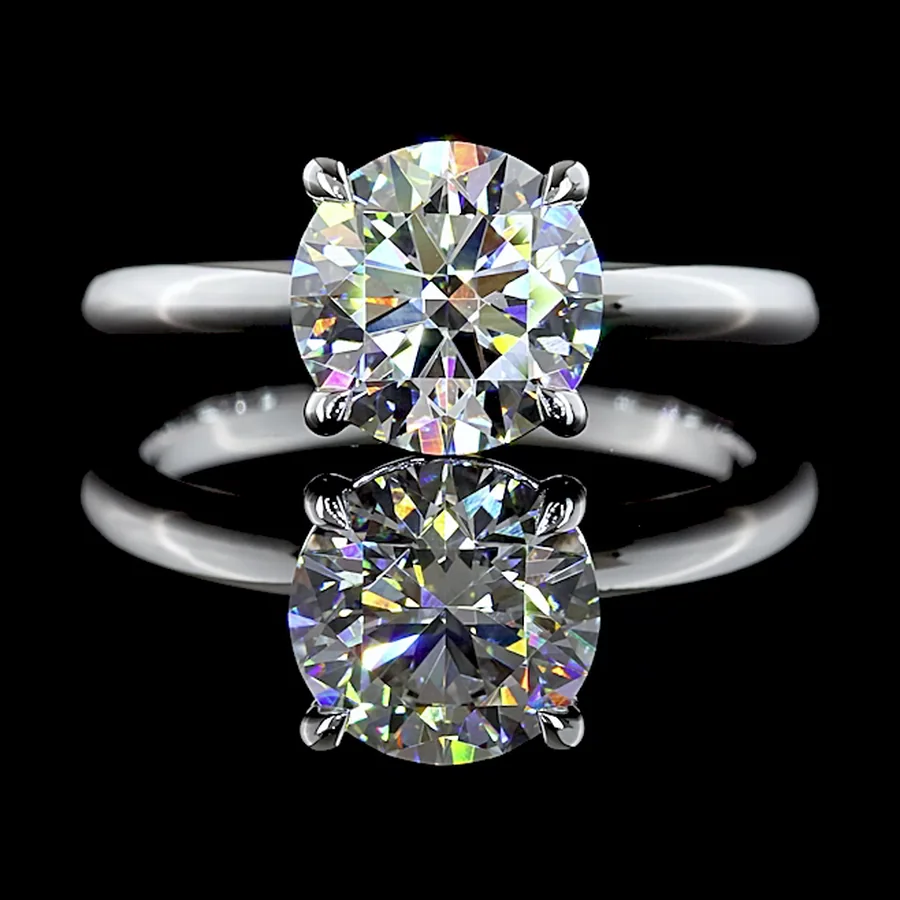
In the hand, that means moissanite throws more rainbow flash, especially in larger stones and under spotlights. Some people like it. To a lot of eyes, and to every trained one, it is the tell. A diamond’s return is whiter and more restrained, which is the look that has defined a diamond for as long as diamonds have been cut.
Moissanite is also doubly refractive: light entering the stone splits in two, and through a loupe the back facets can appear doubled. Diamond is singly refractive, and its facets read clean.
Hardness
Diamond is 10 on the Mohs scale, the hardest material known, and moissanite is 9.25, harder than sapphire, so both are far harder than anything a ring meets in daily life. A diamond holds a sharper facet edge over the years, which is one reason old diamonds still look crisp, but for most wearers this is the difference that matters least.
Color
Lab-grown diamonds are graded on the same D to Z color scale as mined stones, and the Dorvelle round solitaire holds a D, the top of that scale. Colorless moissanite is sold across a range that runs from about D to K against the same scale.
Some moissanite shows a faint warm or green cast in certain light, which the makers have reduced over the years.
Grading and reports
A lab-grown diamond can carry a grading report from a laboratory such as IGI or GIA, stating its carat weight, color, clarity and cut, and whether it was grown by CVD or HPHT. Dorvelle includes a lab report with center stones over one carat. Graded the same way explains how those reports work and what changed at GIA in 2025.
Moissanite has no equivalent independent grading standard. Makers describe their own stones by their own tiers.
Price
Moissanite is priced per stone by its makers and generally costs less than a lab-grown diamond of the same size, though the gap has narrowed a great deal because lab-grown diamond prices have fallen sharply since 2016. Why the metal became the expensive part has those figures. At the sizes Dorvelle sets, the diamond is no longer the expensive part of the piece. The metal is, which is why the piece is sterling silver.
Why we set lab-grown diamonds
Dorvelle sets lab-grown diamonds for three reasons: a diamond is a diamond on the receipt and the report, it is the same stone as the 14k version, and it looks like a diamond across a room.
It is a diamond. The word on the receipt, the word on the lab report and the stone on the hand all agree.
It is the same stone as the 14k version. Every Dorvelle design exists in 14k gold at the house on 47th Street with a lab-grown diamond in it. We put the same stone, same shape, carat, color and clarity, into the sterling version. If we set moissanite in one and diamond in the other, they would be two different pieces.
It looks like a diamond. The restrained white return, the clean facets, the way it reads across a room. That is what people are picturing when they picture the ring.
See the collection. Every page lists the stone’s shape, carat weight, color and clarity.