A ring that is half a size off is a ring you fidget with all day. A ring that is a full size off is a ring in a drawer. You can get close at home with a ruler and ten minutes. Here is how to do it well, and the cases where you should not rely on it.
How ring sizes work
In the United States, ring sizes run in steps of a half or a quarter, from about 3 to 13 for most adults. Each whole size adds about 0.8 mm to the inside diameter of the ring, roughly 2.5 mm to the inside circumference. A half size is about 0.4 mm of diameter. That is less than the thickness of a credit card, which is why careful measuring matters.
A US size 7 has an inside diameter of about 17.3 mm and an inside circumference of about 54.4 mm. Many European countries size rings by the international standard ISO 8653, which simply uses the inside circumference in millimeters, so a US 7 is roughly a European 54.
Our size guide has the full table from size 4 to 9 in half sizes, in both measurements.
| US size | Inside diameter | Inside circumference |
|---|---|---|
| 5 | About 15.7 mm | About 49.4 mm |
| 6 | About 16.5 mm | About 51.9 mm |
| 7 | About 17.3 mm | About 54.4 mm |
| 8 | About 18.1 mm | About 56.9 mm |
Method one: measure a ring that already fits
The most reliable home method is to measure the inside diameter of a ring that already fits the same finger on the same hand, in millimeters, and match it to the size guide.
- Choose a ring that fits the same finger on the same hand. Your ring fingers are different sizes, often by a half size or more, and your dominant hand usually runs larger.
- Lay it flat on a ruler marked in millimeters.
- Measure the inside diameter, straight across the widest part of the opening, edge to edge on the inside. Leave the metal out of the measurement.
- Measure three times, turning the ring each time, and take the middle figure.
- Match it to the size guide.
If you have a pair of digital calipers, even better. Close the jaws inside the ring and read the number.
One caution: the ring you measure should have a band about as wide as the one you are buying. More on that below.
Method two: a strip of paper
If there is no ring to measure, cut a strip of paper about 5 mm wide and 10 cm long.
- Wrap it snugly around the base of the finger, the way a ring would sit.
- Mark where the paper overlaps.
- Before you take it off, slide it toward your knuckle. If it will not pass, loosen it until it does, and mark again.
- Unroll it and measure from the end to the mark in millimeters. That is your circumference.
- Match it to the circumference column in the size guide.
Paper is better than string. String stretches and bunches, and it tends to read small. Even paper is easy to wrap too tight or too loose by a half size, so treat this as a starting point and check it against a second measurement.
Method three: printable sizers
Printable ring sizers depend on your printer printing at exactly 100 percent, which many do not by default. If you use one, check the scale before you trust it. A standard credit card is 85.60 mm by 53.98 mm under the ISO/IEC 7810 standard. Hold one against the printed page. If the reference line does not match the card, the whole sheet is off.
Fingers change through the day
The same finger can vary by a half size between morning and evening, with temperature, time of day, salt, alcohol, flights, exercise and pregnancy all moving it, so measure indoors at room temperature late in the day. A few things move it:
- Temperature. Fingers shrink in the cold and swell in heat. Measure indoors, at a comfortable room temperature.
- Time of day. Fingers are often slightly larger late in the day. Late afternoon or evening is a good time to measure.
- Salt, alcohol and flights. All of them can cause temporary swelling.
- Exercise. Measure after you have cooled down, not right after a workout.
- Pregnancy. Fingers often swell during pregnancy. Size for your usual hand, and plan to wear the ring on a chain or another finger for a while if needed.
The goal is a ring that slides over the knuckle with a little resistance and sits without spinning freely. If your knuckle is noticeably larger than the base of your finger, size for the knuckle. The ring has to get past it.
When not to trust a home measurement
A home measurement is not enough for an eternity band, a band wider than about 6 mm, a reading that lands between sizes, a surprise proposal with a borrowed ring, or a measurement taken on an unusually cold or hot day.
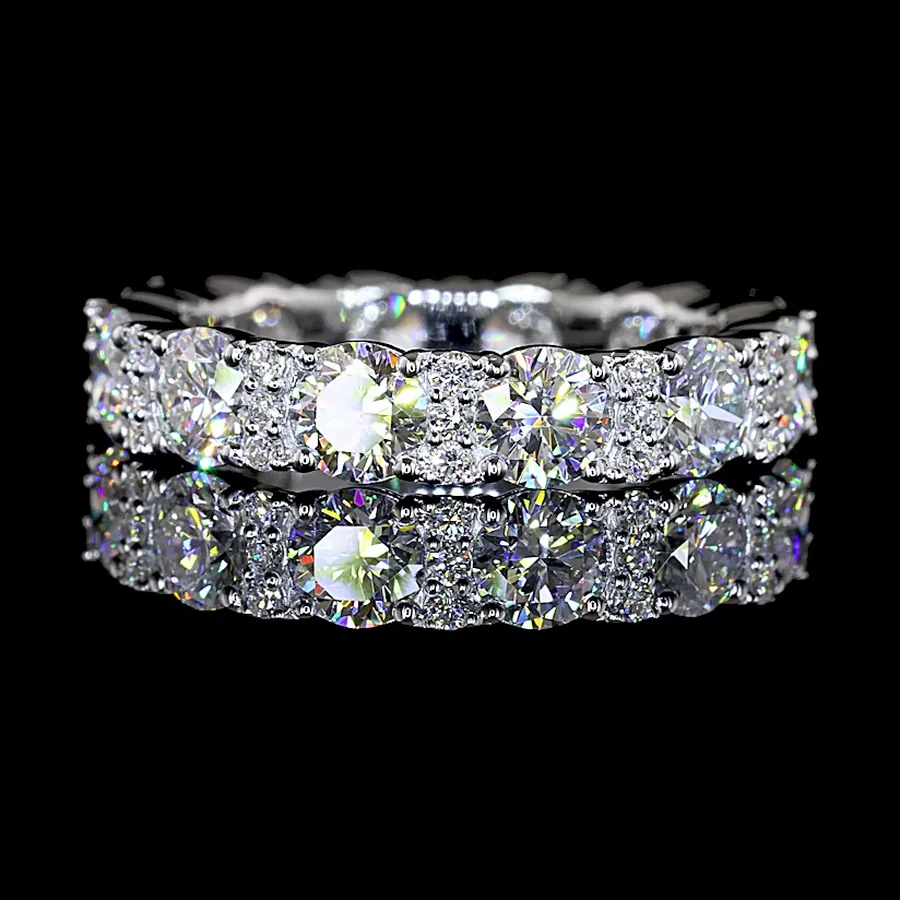
Eternity bands. An eternity band is set with stones all the way around, so there is no plain metal to cut and resize. The size you order is the size you keep. Measure twice by two methods, and ask a specialist before ordering one.
Wide bands. A band wider than about 6 mm covers more of the finger and feels tighter than a narrow band of the same size. People often go up a quarter or a half size for a wide band. If your reference ring is narrow and the one you want is wide, ask before ordering.
Between sizes. If your measurements land between two sizes, the right answer depends on the band and your knuckle. Send us both numbers and we will help you choose.
Surprise proposals. The classic move is to borrow a ring from the jewelry box. Make sure it is a ring worn on the left ring finger, not the right hand, and not a ring worn on a different finger. If the only ring available is a right-hand ring, it will usually run a little large for the left. Tell a specialist what you measured and on which hand.
Cold days and hot days. If you measured on a winter morning or in a summer heat wave, measure again on an ordinary day.
The right path
Start with a ring that fits and the size guide, and if anything above applies to you, or your numbers disagree, text us or ask a specialist before you order. The people who answer are the house on 47th Street’s own.
Size matters more for some designs than others. Our straight answer on sterling silver for an engagement ring covers how resizing works on a silver ring.
When you know your number, the bands are ready. See the bands.